
Besa Vormatu-Dzelumadzekpo
Sustainable Tourism Development
Ecotourism - Kakum National Park
As part of the effort to conserve biodiversity and protect plant and wildlife species in Kakum Conservation Area, the project initiated the ecotourism project.
The project aimed at:
-
Generating revenue to conserve biodiversity and maintain the infrastructure built by the project
-
Creating economic incentives for national, regional and local authorities to protect natural resources
-
Providing alternative income sources for communities surrounding Kakum Conservation Area
-
Creating awareness of the value of natural resources through education, interpretation, design, attractions and activities
Visitor Center:
The visitor center is built on what was a palm fruit plantation on the edge of the Kakum forest. It was built with local materials and stones from a near-by quarry.
Canopy Walkway:
From the treetops experience a unique and spectacular view of the rainforest canopy with the opportunity to see flora and fauna seldom seen from the ground. The Walkway has seven bridges with tree platforms for viewing the surroundings.
Hidden Connections:
This interactive exhibit focuses on the connections that make the rainforest a web of life and highlights the cultural connections with the Akan people from southern Ghana. Hidden Connections was designed by the Smithsonian Institution (SI).
Kakum Rainforest Café:
Both local and international cuisine is served at the Rainforest Café and the Café is an excellent place to relax during your stay at the Visitor Center. In addition to the restaurant, a Fast Food area is open for purchase of snacks and minerals. The restaurant caters buffets for large groups.
Kuntan Trail:
With an experienced guide, visitors can learn about the various medicinal and practical uses of forest plant species while hiking along the Kuntan Trail. One and two hour hiking options are available.
Afrafranto Campsite:
Located just 200 meters from the Kakum Visitor Center, the Afrafranto campsite has capacity for twelve (12) adults or sixteen (16) children. The campsite provides an excellent accommodation option for the adventurer and a base for early access to the Walkway. The campsite is equipped with two biological toilets and two shower facilities and six raised and roofed sleeping platforms. Visitors must bring their own tents, mosquito nets, sleeping pads or cots.
Night hikes in the Forest:
A one-hour trail has been developed for night hikes in the forest, which depart at 8:00 pm. The guides can take up to 8 persons in one night-hike group though two guides may go on separate trails each night.
Sunbird Trail:
A birding trail that covers territory in the rainforest, the secondary forest and a pond environment has been developed for birders. There are more than 400 species of birds on the Kakum checklist and the Sunbird Trail is an excellent place to look for them. Groups of up to eight persons may go on the trail at one time. The guides will have basic texts on birds and one pair of binoculars.
Kukyekukeyku Bamboo Orchestra:
Each Saturday from 9:00 am to 2:00 pm in peak season, the Bamboo Orchestra from Mesomagor village performs at the Visitor Center.
Mesomagor Community Ecotourism Development
A community ecotourism development in which conservation, history, culture, agriculture, economic development support one another as an ecotourism experience.


Me on the Canopy Walkway at Kakum National Park

The Tree Platform in Kakum National Park near Mesomagor
Nyame Bekyere Kukyekukyeku Bamboo Orchestra performing
Bole Hippopotamus Project
Ecotourism Development
The Common Hippopotamus, Hippopotamus amphibius – one of Africa’s large mammals – is globally endangered, according to IUCN. It occurs exclusively in Africa, south of the sahara in a patchy distribution throughout its range. Even though in the past it was believed to be widely distributed in Ghana, it is now mostly restricted to portions of the Black Volta River, particularly within and just outside the Bui National Park. There are also small populations along this river stretching up to Burkina Faso and possibly in the Kulpawn River. All populations outside the National Park suffer a risk of human predation.
The objectives of the project include:
-
Assessing the distribution and population status of the hippopotamus in the Black Volta and Kulpawn Rivers;
-
Identify suitable habitats just outside the Bui National Park (in the Bole District of the Northern Region) that can be designated as “Hippo Sanctuaries” in conjunction with the local authorities and communities;
-
Develop a conservation strategy for hippos in the area;
-
Develop ecotourism in the area.
Historic and Cultural Tourism
Castle Tours
Cape Coast Castle (1563)
‘Cabo Corso,’ meaning ‘short cape’, is the name the Portuguese settled on for the local settlement within which its trade lodge was built in 1555. Its corruption to ‘Cape Coast’ is now the accepted name of the capital of the Central Region of Ghana. The Swedes, led by Krusenstjerna, however, were the initiators of the permanent structure presently known as Cape Coast Castle. They built a fort in 1653 and named it Carlousburg, after King Charles X of Sweden. Its proximity to St. George’s Castle (Elmina Castle) and its sheltered beach were all forceful ‘pull factors’ for European nations to the Cape Coast. In addition, the immense viability of the area’s trade implied that the ensuing quest for control led to the Swedes having trouble holding on to their fort. It was captured in turn by the Danes and the local Fetu chief. Dutch occupation commenced in 1660. Finally, the British fleet, led by Captain Holmes, conquered the fort in 1665 and by 1700, had upgraded it into a castle. Colonial rivalry between England and France peaked in 1757 during the Seven Years’ War. A French naval squadron bombarded Cape Coast Castle, leaving it badly damaged, and after 1760, the English reconstructed the castle entirely - with more durable materials and an improved sea defence system. The English retained control of the Castle into the late 19th century. The slave trade was principal until its ban in 1807 by the British, and it ‘is estimated that around 1700, the Royal African Company was exporting some 70,000 slaves per annum to the New World’ . After 1807, trade centred on precious metals, ivory, corn and pepper. In the eighteenth century, the castle’s role altered, as it became the centre of European education in Ghana. The Cape Coast Castle has served as the West African headquarters of the president of the Committee of Merchants; the seat of the British governor; and a school.
The castle’s opening hours are 9:00am to 4:30pm daily.
Elmina Castle (1482)
Renowned as the first major European construction in tropical Africa, St. George’s Castle, in the town of Elmina in the Central Region of Ghana, was founded by the Portuguese in 1482. The site of the Castle was selected by Portuguese navigators, as it was advantageously located at the end of a narrow promontory , a stone’s throw away from both the Atlantic Ocean and the Benya River. The lee of the low headland provided an excellent natural harbour. St George’s Castle or ‘Sao Jorge da Mina’, after the patron-saint of Portugal, as the castle was known to the Portuguese, afforded the Portuguese a trade monopoly in the area, with unrivalled access to the region’s gold. The sheer magnitude of trade volumes resulted in labour challenges, as navies were unable to convey the large quantities of European goods to all markets. The importation of slaves from Benin in exchange for gold and ivory in the early 16th century was the identified solution. However, not long after, the influx of superior gold from Mexico into Europe caused gold prices to plummet rapidly. The economically distraught Portuguese were easily ousted from Elmina in 1637 by the Dutch. The main Dutch trades were gold and slaves; they reconstructed the castle between 1770 and 1775. Until 1872, the castle served as the focal coordinating point for Dutch Gold Coast activities. In 1682, the author Jean Barbot described St. George’s Castle as having ‘no equal on all the coast of Guinea’ , with respect to beauty and strength. On 6th April, 1872, the castle was ceded to the British. In recent years, it has served as Police Recruit Training Centre, a secondary school, and it is presently a historical museum. St. George’s Castle is featured on the UNESCO World Heritage List. Next to the castle is a picturesque fishing harbour, and within walking distance are sites such as Fort Coenraadsburg (St. Jago), the Dutch cemetery, and the ‘Posuban’ buildings of Elmina.
The castle’s opening hours are 9:00am to 4:30pm daily.
Cape Coast Castle Museum
"Crossroads of People, Crossroads of Trade"
The Cape Coast Castle Museum is housed in one of the wings of Cape Coast Castle, in the Central Region. The Cape Coast Castle Museum aims to educate its visitors about the advent of Europeans to Africa and their interactions with the local communities and the Central Region in general. Visitors can view maps of slave trade routes and look at examples of the objects which were traded in for slaves – such as glass beads, whisky bottles, and firearms. Representations of the hold of a ship, as well as auction blocks, have been constructed to simulate for guests a tiny part of the experience of the enslaved. The museum also includes exhibits on the pre-colonial history of the Central Region, in addition to displays on its contemporary culture. Visitors can view a video documentary on “Cross Roads of Trade, Cross Roads of People” putting into context the interactions between the Africans at Home and those in the Diaspora.Exhibits include: gold weights and measuring scales; state swords; guns; stone implements for hunting; paintings; terracotta figurines; a palanquin (a structure used to carry chiefs); life size European engravings that depict West African scenes; maps of the slave trade routes; examples of items exchanged for slaves; shackles; a black-and-white print of the slave ship, nineteenth-century engravings of captives onboard a slave ship; clan staffs; a canoe; photographs of famous black people through the years; traditional cloths; carved wooden utensils; musical instruments; and a model of Cape Coast Castle.The Cape Coast Castle Museum’s facilities include conference halls; a library; an art and craft studio; a book store and gift shop; curio shops, a car park; and an open courtyard for outdoor activities. The Cape Coast Castle also hosts the Building History Museum. There is also a 45-minute guided tour, which allows visitors to view the castle’s dungeons, the condemned cell and the “Door of No Return”.
Elmina Castle Museum
"Elmina Across the Centuries"
The St. George’s Castle Museum is located within St. George’s Castle (often called ‘Elmina Castle’), a fortress in the Central Region. The purpose of the museum is to educate the public on the history of St. George’s Castle, as well as to preserve the cultural heritage of the Central Region. Exhibits include: photographs representing the images of St. George’s Castle across the centuries; displays on the Asantes of Elmina, and on local trading activities with the Europeans; gold weights; shackles; murals; local textiles, stools, stone implements, ceramics, bottles, clay, glass and beads. The museum provides tours of St. George’s Castle. Visitors may absorb the sights of the former storehouses and slave dungeons, chapels and governor’s chamber. Another scene of interest is the cell where a King of Asante was once held prisoner. Visitors will also be afforded the opportunity to capture some bird’s eye photographs of the surrounding harbours, fishing boats, and the nearby Fort St Jago, all from the battlements of the four-storey St. George’s Castle. After a tour of the castle, a chance to rejuvenate is on hand at the museum’s restaurant and bar. A bookstore and a gift shop are also available, and the museum provides visitors with access to a car park. There is an open courtyard for outdoor activities.
Walking Tours in Cape Coast and Elmina
-
Waling Tours of Cape Coast Historic District and its environs
-
Walking Tours of Elimina
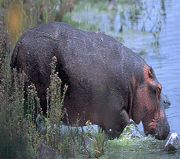
A hippopotamus in the Black Volta River

Prof. Maurice Cox with architecture students from the University of Virginia.


The Cape Coast Castle Museum "Crossrads of People, Crossraods of Trade"

Elmina Castle Museum "Elmina Across the Centuries"